Tag: Transexual

  • Trannies in Trouble

    Trannies in Trouble

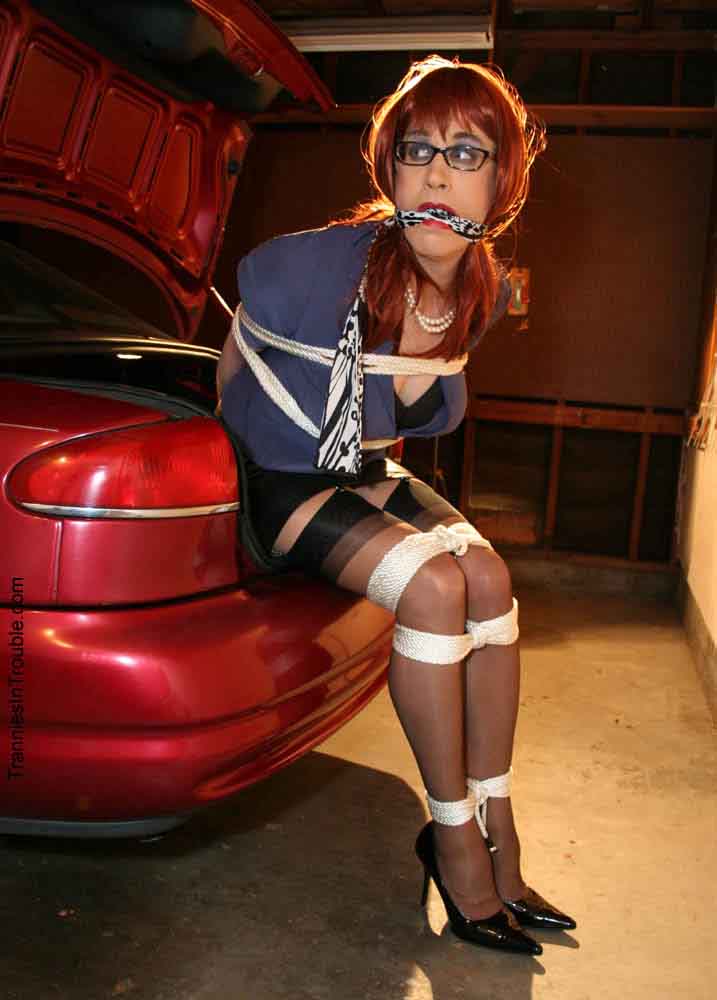
    Well, for many years I had fantasies of modeling for bondage pictures, so it’s been a long path to finally get to Trannies In Trouble. I’ve been around quite a while and plan to continue on as a bondage photographer once I feel I’m too old to be in front of the camera. But when I was young and in college, I used to go to adult bookstores to look at bondage magazines – this was really before the internet had become popular – and I remember what a thrill it was and how forbidden and even risky it felt to go to these stores. The first time I saw a wall of bondage magazines in an adult bookstore, I was stunned. It was like, OMG, I’m not the only one who’s into this stuff. Nowadays erotic material is so easily available that it’s really lost some of the charge that it had back when you’d have to go to a special naughty bookstore and summon up the courage to walk through the door, usually hidden around back.
    4

    But even back then I wanted to pose for bondage pictures and take photos of other girls and other CDs. There weren’t many images of CDs in bondage but there were a few and I remember wondering if I could look good enough to take some nice pictures someday. I started rather late with dressing more seriously, and probably didn’t have a halfway decent “look” put together till well into my mid-thirties, and then when I finally moved to L.A. back in 2001 I met up with a nice group of people who ran the website “SweetTies,” which is still online. I was able to pose for some photos for them a few times, and then when they moved away, I started taking pictures on my own. It sounds crazy but I actually came up with ways to tie myself up and take photos of myself with the camera on a tripod, using a remote control. It was very crude and took forever but some of those photos are still on my website and some of them were pretty effective. I’d like to think that I’ve improved some since then and I’ve certainly met many excellent photographers and models over the years who have helped out so much, especially my friend Delilah Knotty, with whom I’ve been shooting for years. She no longer models on my site but that girl still ties my ass up tight!
    3

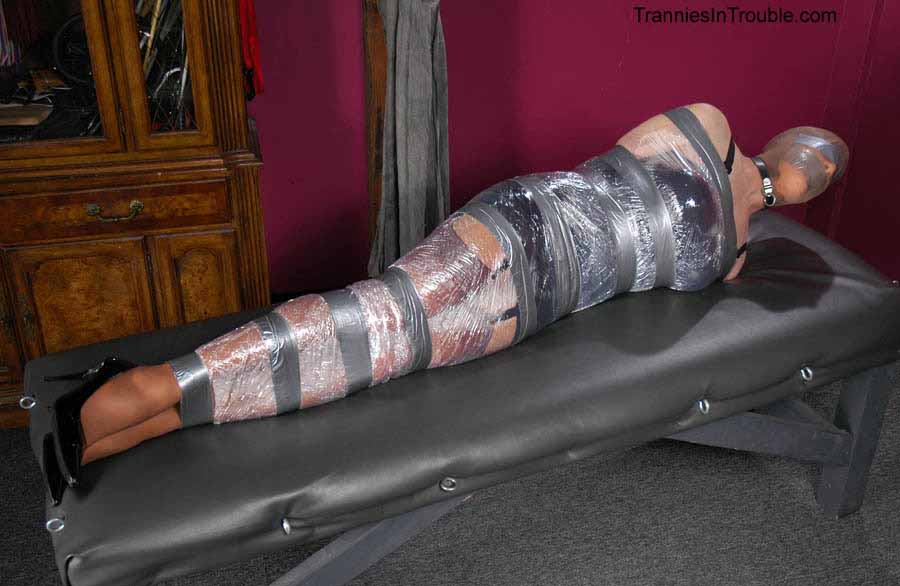
    But basically the whole concept of Trannies in Trouble was just to do damsel in distress style bondage but feature crossdressers as the stars of the show. This is a very narrow niche, obviously, and there are very few websites in this genre. There is some overlap though, of course, with damsel in distress sites featuring women, as many of my customers enjoy seeing both women and CDs in bondage. But like I say, it’s a fetish and many of the guys who like these sites are crossdressers themselves, or trans, or guys who simply identify with the image of a woman tied up and in danger.


    Images courtesy of Sandra Gibbons

    Have an amazing experience or tips you like to share on SimplySxy?
    Drop us an email at editorial@SimplySxy.com!
  • Gendering Outside the Lines (Part 2)

    Gendering Outside the Lines (Part 2)

    Read Part I here

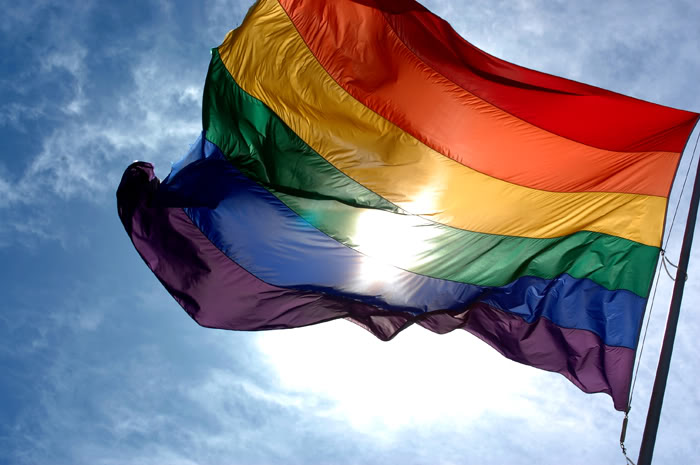
    Some of the terms I used in my introduction to describe my gender identity and gender discovery journey are likely unfamiliar to you. Here’s a quick vocab lesson to go with my first post:

    Assigned Female at Birth (AFAB), also Assigned Male at Birth (AMAB): these terms acknowledge that the gender that ends up on your birth certificate is determined based on external examination of your genitals and assigned by someone other than the person being born. That assigned gender may or may not correspond to the gender identity that person eventually recognizes for themselves. So, in my case, when I was born, everyone in the room (other than me) took a look and decided I was female.

    Transmasculine is a term used to describe people who are AFAB and identify as masculine in some way and/or are masculine in appearance. Genderqueer is a term some people use to describe identities that are not male or female, but perhaps a combination of them or transcending them entirely. I use genderqueer as a shortcut to describe my gender identity which is a combination of male and female, though I do not specifically identify as either.

    Because I’m genderqueer, you can also say that I don’t identify with the gender binary. Another term you might have seen is ‘trans*’. This is a term some people use to broadly describe people who identify as transgender, transsexual or other gender non-conforming identities. I sometimes describe myself as a trans* genderqueer butch. Be aware that in some circles, this is a controversial term, however it is one I use to describe myself and other nonbinary identified people.

    ‘Non-binary’ is another term we should explore and we’ll do that by first talking about what binary means. A binary system is one with two choices, like on/off or black/white. When we talk about the gender binary, we’re talking about male and female being the only two terms we have when describing gender. For most of my life, I didn’t question that system or the limitations it imposed. Our culture uses the gender binary to define what roles, characteristics and appearances are acceptable for everyone based on their perceived gender. When I identified as a butch female, I was gender non-conforming. That means I wasn’t playing by the rules for being a female in American culture. I didn’t wear dresses, or keep my hair long and feminine. I embraced masculinity and put me outside the gender norms. Even as I chafed at the limitations assigned my gender, I still didn’t question the binary itself.

    Sit for a moment and imagine living outside that binary, imagine not being constrained by male and female. Can you do it? Can you think of a time when you didn’t feel intrinsically male or female? Even for people who are trans* identified, it can be a challenge. Most people relate to the gender binary in a positive way, for example trans women who identify as female or trans men who identify as male. But I am becoming more and more aware of people like me who occupy that gray area in between (or maybe outside) the binary.

    I first discovered this gray area through blogs and essays and eventually met some nonbinary people in person. I had a growing realization that this way of seeing gender, outside the restrictions of the binary, resonated with my internal vision of myself. I began to identify as genderqueer and tell people about the way gender intersected in me. The ongoing challenge is that it is really hard to explain not being male or female to binary identified people. Typical reactions are confusion, disbelief, even mockery – maybe you can relate to one of those.

    This being my first post here, I don’t want to go on and on, better to leave something for the next time. In my next installment, I will address a couple more things I spoke about in the second paragraph – my pronouns, name change, testosterone and how that reconciles with not being male.

    If you have questions for me on the topics I’ve raised here or questions you hope I’ll address in future posts, please leave them for me in a comment. You can also find more on these topics (and more) on my blog, Butchtastic.


    Image courtesy of Photobucket
    Have an amazing experience or tips you like to share on SimplySxy?
    Drop us an email at editorial@SimplySxy.com!

  • Gendering Outside the Lines (Part 1)

    Gendering Outside the Lines (Part 1)

    I was invited to contribute to this site and share my trans* perspective on sexuality and gender. To be perfectly clear, I am only qualified to speak from my own perspective and though my viewpoint will sometimes overlap with that of other people, there are times when it will not.

    Since I’m new here, I’d like to take a moment to introduce myself. I am a 51 year old transmasculine genderqueer who was assigned female at birth, uses he/him/his pronouns and is taking testosterone (T) to better align my physical body with my gender identity. I recently completed a legal name change to a typically male name which is similar to my birth name. Though I identify as trans* and masculine, I do not identify as male.

    I started taking T last year after a lifetime of not really fitting into my expected role as a female. Even as a masculine lesbian female – dyke, queer, butch – there was something that didn’t work for me, like a pair of underwear that rode up in the wrong places and also felt too loose. Yeah, it was that uncomfortable. Over the years, I watched as some of the other butches I knew chose transition from female to male, becoming trans men. I pondered their choice and thought about my own discomfort in being female, but something held me back.

    That something was the fact that though I do not identify as female, I also don’t identify fully as male. Combine that with my assumption that only male identified people went through transition and I was at a stalemate. Years went by as I learned more and more about gender identification and how complex it was. I hadn’t put my own situation into words, because the idea of not being female but also not being male wouldn’t fit into my head any better than a square peg in a round hole. You may be feeling similarly at this point, how does a person not feel either female or male, what else is there?

    I didn’t know it for many years, but I was on a quest to find the words to describe my sense of gender. The main problem was that the words didn’t exist yet. The words ‘genderqueer’ and ‘non-binary’ were outside my knowledge until about five or six years ago, and they hadn’t been in common usage much before that. When I came across the definition of genderqueer, I felt like my brain suddenly expanded like a giant sponge animal dipped in water. All of a sudden, there was more room in the world, more reality to explore and occupy. The thing I’d been chasing, my own personal golden chalice, had a name, it existed in the way that it hadn’t before because now I had a word for it, and a new understanding about gender.

    I’ve thrown a lot of terms in the preceding paragraphs that may be unfamiliar to you. You aren’t alone, I’ve had countless conversations with people over the last several years about the terminology used to describe gender identity and those conversations started with me being very ignorant.

    Read part 2 here


    Image courtesy of Photobucket
    Have an amazing experience or tips you like to share on SimplySxy?
    Drop us an email at editorial@SimplySxy.com!

  • Challenges of a trans-lesbian

    Challenges of a trans-lesbian

    For lesbian, dyke, or queer-identified transgender women, most of us have had the most difficult time with acceptance. That is, accepting ourselves, having other women accept us, being accepted in women’s community, and desiring each other as women.

    When I came out as a trans woman, I was able to find that courage after years and years of shame. I thought I’d never become an “acceptable” woman – one who wanted to wear high heels, grow out her hair, “pass,” and be desirable to women. As I grew up and found myself as a feminist, I tried to reject these presumptions and stereotypes about trans women. At the same time, I found myself shameful about “wanting to be” a woman (even though I already was deep down inside). It was only when I saw different trans women in porn, trans women who fucked and loved other women, that I was able to say, “Holy crap, that’s totally me, and I can totally do this.”

    In a short time, I turned to sex work, as many trans women have done, partially for money reasons, but mostly because it worked for me and I wanted to do it. I continued to find myself as a kinky, queer woman through dominatrix work, and independently produced porn. While sex workers are painted as victims by society, I’ve found this mostly to be completely untrue. I’ve found it, like everything in life, to be much more complicated.

    My experience of being a trans dyke, and my relative privileges, has made me consider engaging in sex work that is most gratifying for me. When I, fortunately, came into some money, I wanted to invest that in producing great porn featuring non-straight trans women. So I came up with TransLesbians.com.

    While it’s generally unknown how many trans women identify as straight, bisexual, lesbian, or queer in the U.S., my experience working and meeting other trans women has proved that we have a very wide variety of sexual orientations. Anecdotally, I’ve known most trans women to be non-straight — and this applies to those of all different types of race and other backgrounds. Perhaps one of the most comprehensive and recent surveys by the National Gay & Lesbian Task Force agrees with this evidence.

    My sex work, and more specifically my porn, has attempted to show lesbian or non-straight trans women as authentic and complicated people with just as varied sexualities as cisgender women. When creating TransLesbians, my goals sound deceptively simple:

    1. Showcase really hot, nasty gonzo-style porn between trans and cisgender women without using the terms “tranny” or “shemale.”
    2. Capture real attraction and sizzling chemistry.
    3. Hire an all-trans women staff for support behind the camera.
    4. Provide a safe, comfortable, and responsible workplace.
    5. Pay performers as close to industry-standard rate as possible, and try to create a sustainable income for non-straight trans women sex workers.

    Undoubtedly, the challenges faced by lesbian and queer-identified trans women are as deep and complicated as how one experiences their identity. My unending hope is to create, first and foremost, a positive experience of trans women, and that this will inspire many more of us to find ourselves and embrace each other as women.


    Image courtesy of Emma Claire
    Have an amazing experience or tips you like to share on SimplySxy?  Drop us an email at editorial@SimplySxy.com!